The Roll of Arms of Bexar County, Texas, records the arms borne by the governments, military commands, institutions, and persons of this county and its neighbouring country — each entered with its blazon and the authority for it. The College of Arms of Bexar keeps the Roll and admits no entry that is not documented; what is shown is the heraldic element alone, never a seal or a logo in its place.
State of Texas
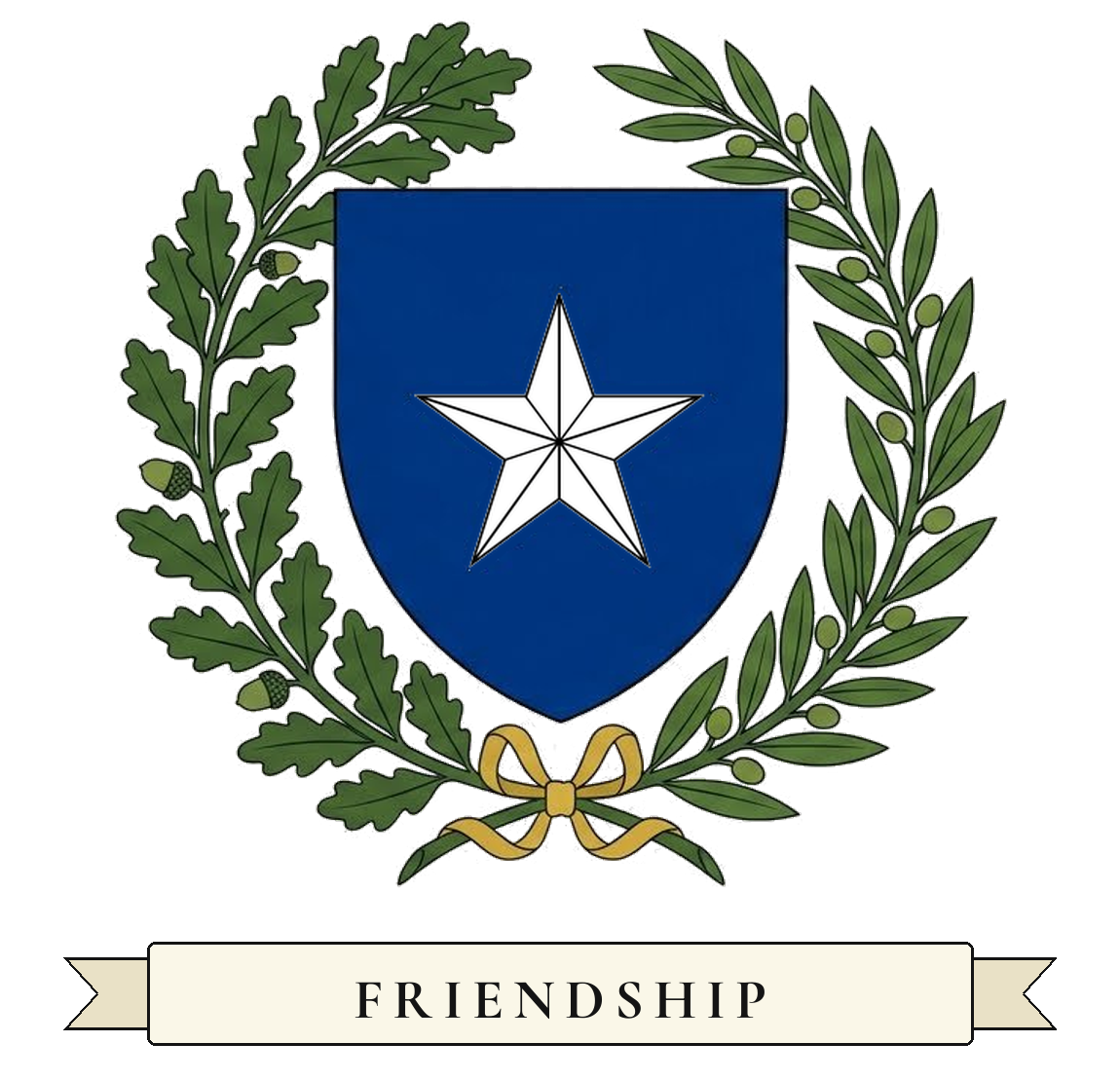
Emblazonment by this College from the statutory blazon (Texas Government Code § 3101.002(a)): the shield Azure with the mullet Argent; the olive and live oak branches borne as supporters, tied with a ribbon Or; below, the motto Friendship on a scroll. The State's standard design as published bears the device alone, with no shield or ground; see the note.
Blazon — "The state arms are a five-pointed white star, on an azure background, encircled by olive and live oak branches." (Texas Government Code § 3101.002(a), carrying forward the Act of the Congress of the Republic of Texas of 25 January 1839.) Azure, a mullet of five points Argent.
Motto — Friendship
The arms of the sovereign State, entered at the head of this Roll, under whose law the arms of Bexar County below were adopted. No other sovereign arms are recorded in this Roll. The State's motto is Friendship (Texas Government Code § 3101.004; adopted 1930) — the meaning of the name Tejas itself, from the Caddo táyshaʼ, 'friends' or 'allies.' The words REMEMBER THE ALAMO, emblazoned above the shield on the reverse of the seal (§ 3101.001), are the seal's, not the State's motto. This is a roll of arms, and the entry is a full achievement emblazoned from the statutory blazon: the star on its azure ground borne on a shield; the olive and live oak branches that the blazon sets around the star borne as supporters of the shield, live oak dexter, olive sinister. (The mullet encircled by the branches is borne as a crest, on a wreath of the colors Argent and Azure, by the Texas Army National Guard.) A READER'S QUESTION ANSWERED: these arms are not the state seal, and the two are often confused. The standard design adopted by the Secretary of State by rule in June 1992 (art by Juan Vega, of the Texas State Seal Advisory Committee; 1 Tex. Admin. Code § 72.2), made for the State's reproduction, publishes the device with no ground and no shield, and in that form the arms are commonly shown as the star and branches alone, distinguished from the seal by the absence of the words THE STATE OF TEXAS that the seal wraps around the device. Earlier renderings by this College are withdrawn. The older depictions differ among themselves — the Republic's $3 treasury note of 1841 shows the star alone on a round shield; an 1876 lithograph shrinks the star and wreath into a medallion set on a larger shield — and each is recorded here as a variant, not followed.
Bexar County
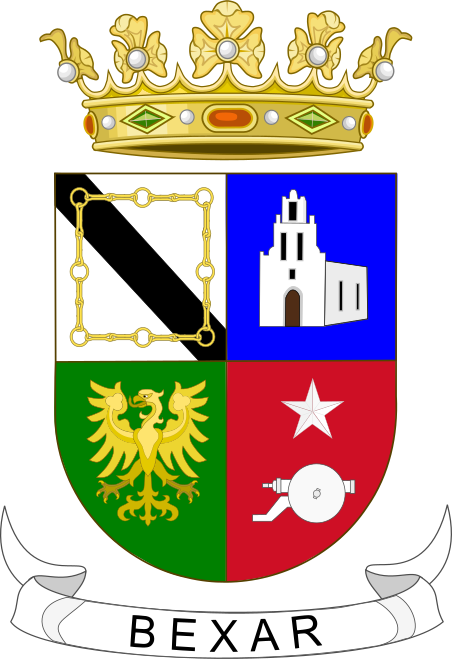
The county's official arms as published (depiction via Wikimedia Commons). Placeholder image, pending the College's standard rendering.
Blazon — Quarterly: first, Argent, a bend Sable, an orle of eight chain links Or overall; second, Azure, Mission San Francisco de la Espada Argent; third, Vert, an eagle displayed Or; fourth, Gules, in chief a mullet and in base a cannon, both Argent. Above the shield, a Spanish ducal coronet; below, a banner inscribed BEXAR.
The official coat of arms of Bexar County, adopted by the Commissioners Court on 22 December 1971 (the county website's symbols page gives 1972; the county history gives 1971, with the fuller account). Designed by Thomas A. Wilson and illustrated by Ramon Vasquez y Sanchez; confirmed and approved by Fernando Muñoz Altea, King of Arms of the Royal House of Bourbon-Two Sicilies. The first quarter bears the arms of Don Álvaro de Zúñiga, Duke of Béjar, with the gold chains of Navarre; the cannon in the fourth quarter is turned toward the eagle of the third, for the wars Texas fought with both Mexico and the United States.
City of San Antonio
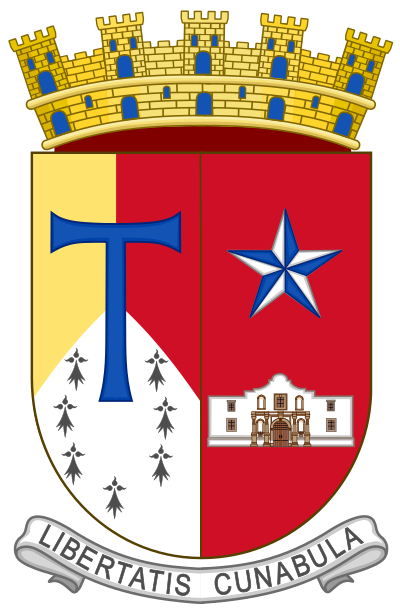
The city's arms as published (depiction via Wikimedia Commons). Placeholder image, pending the College's standard rendering.
Blazon — Per pale: dexter, Or and Gules over Argent semy of ermine spots Sable, overall a tau cross Azure; sinister, Gules, in chief a mullet Azure and Argent, in base the Alamo Argent. Above the shield, a mural crown Or; below, a banner inscribed LIBERTATIS CUNABULA. (Blazon rendered descriptively from the published depiction; the official blazon is to be confirmed.)
Motto — Libertatis Cunabula
The arms of the City of San Antonio as published. The tau is the cross of Saint Anthony of Padua, the city's patron; the sinister side bears the Lone Star above the Alamo. The motto, Libertatis Cunabula — Cradle of Liberty — is the city's own, carried also on its seal (designed 1925 by Johannes C. Scholze; designated the official seal in 1981).
University of Texas at San Antonio
The escutcheon from the centre of the crest of UT San Antonio (depiction via Wikimedia Commons, public domain as a simple logo; the crest itself is a trademark of the University) — the full crest rings it with the University's name — with the University's motto on a scroll beneath, added by this College. Shown for identification.
Blazon — A shield Orange cut by three grooves embowed Argent, the base tier ending in an upward point. (Blazon rendered descriptively from the published depiction; no official blazon exists. The shield stands at the centre of the University's circular crest, ringed by the words THE UNIVERSITY OF TEXAS AT SAN ANTONIO.)
Motto — Disciplina Praesidium Civitatis
The crest of the city's public research university, founded 1969. The circular crest was adopted in 2025 for the unified UT San Antonio, formed on 1 September 2025 by the merger of the University of Texas at San Antonio with the University of Texas Health Science Center at San Antonio. The University's own account of the mark: its stacked tiers are the crested waves of the San Antonio River Basin — the confluence of rivers, and of ideas — its base point an upward arrow of momentum and aspiration, and its shield an emblem of trust, academic rigor and protection. The University's motto, carried on its official ring, is Disciplina Praesidium Civitatis — 'A cultivated mind is the guardian genius of democracy,' the words of Mirabeau B. Lamar, second President of the Republic of Texas; it is the motto of the University of Texas System. The crest is a modern trademark device, not a grant of arms. Recorded here for identification; this entry implies no affiliation with, and no endorsement by, the University.
Archdiocese of San Antonio
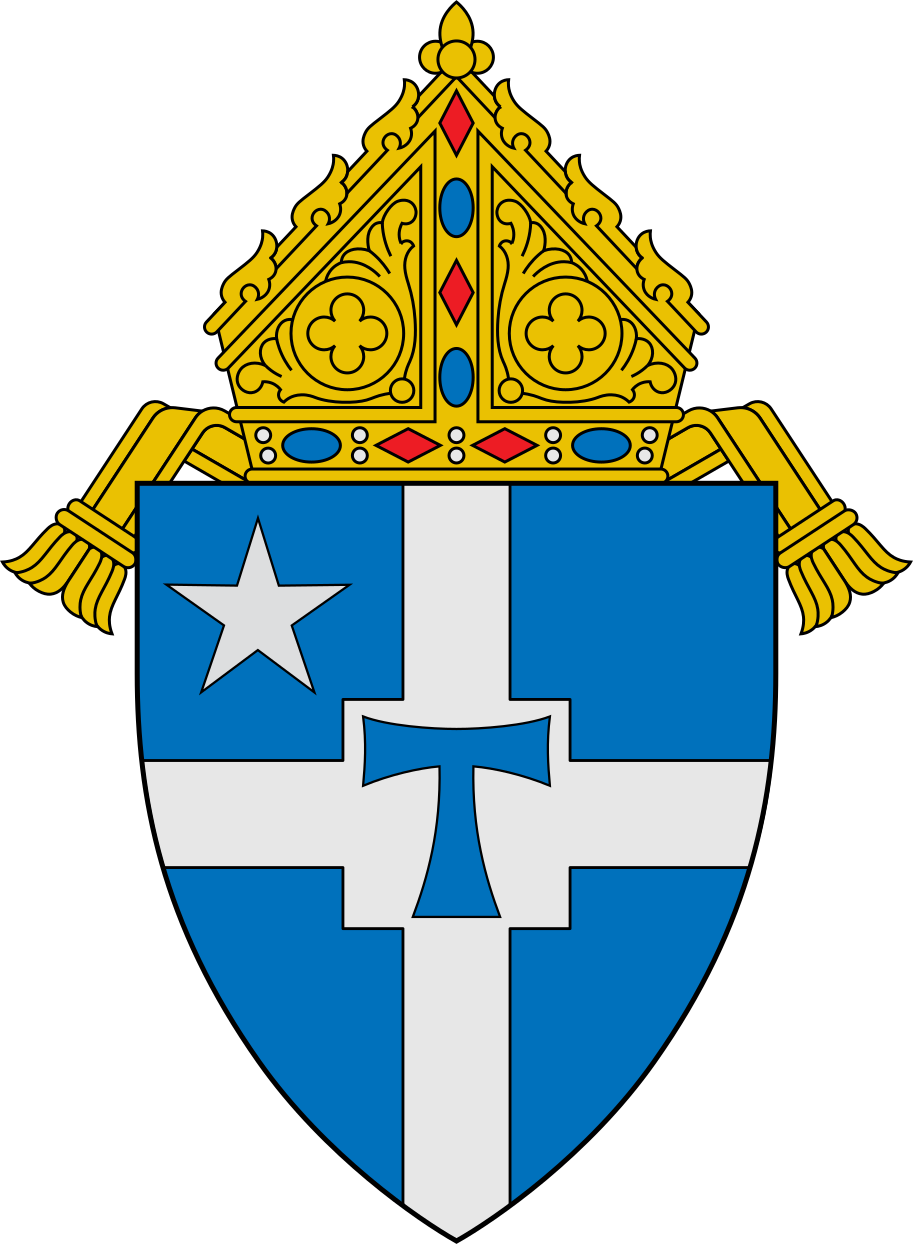
The arms of the Archdiocese as depicted on Wikimedia Commons (depiction by Linestamp, released into the public domain under CC0).
Blazon — Azure, on a cross quadrate in the centre Argent a Tau-cross of the first; in dexter chief a star of the second. The shield is ensigned with a mitre. (Blazon as recorded in Heuser, Some Recent Episcopal Arms, The American Ecclesiastical Review, 1916.)
The Roman Catholic archdiocese erected as the Diocese of San Antonio on 28 August 1874 and raised to an archdiocese on 3 August 1926; its cathedral is San Fernando, and its territory includes Bexar County. The tau is the crutch-cross of Saint Anthony of Padua, the city's patron; the star is the Lone Star of Texas. The same tau appears in the arms of the City of San Antonio in this Roll. Recorded here for identification; this entry implies no affiliation with, and no endorsement by, the Archdiocese of San Antonio.
Lyndon B. Johnson
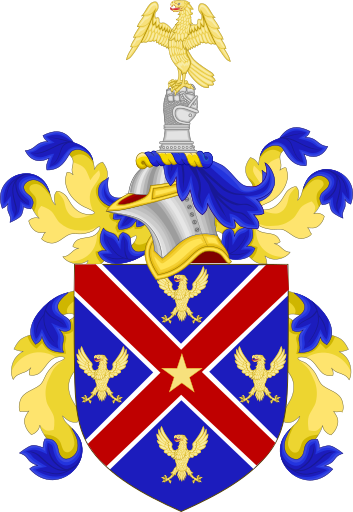
The arms of President Johnson with their crest, as depicted on Wikimedia Commons (depiction by Glasshouse, using elements by Sodacan and Heralder, CC BY-SA 4.0).
Blazon — Azure, on a saltire Gules fimbriated Argent between four eagles displayed, a mullet Or.
Crest — On a wreath of the colors, an armed hand Argent supporting an eagle rising Or.
Motto — Nobilitatis virtus non stemma character
The personal arms of Lyndon Baines Johnson (1908–1973), thirty-sixth President of the United States. They were granted to him at his own request on 1 June 1968 by the American College of Heraldry and Arms, and presented to him in the Oval Office on 10 June 1968 by Donald Stewart, with Senator Daniel Brewster in attendance; the grant papers are held by the Lyndon B. Johnson Presidential Library. The granting college was a private American body, founded in Maryland in 1966 and closed in 1970: not a sovereign heraldic authority, and not the American College of Heraldry founded in 1972. The grant therefore stands in a different class from President Kennedy's grant of 1961 from the Chief Herald of Ireland, or President Eisenhower's arms as a knight of the Danish Order of the Elephant. The motto is the old Johnson family motto: virtue, not lineage, is the mark of nobility. Johnson was a Hill Country man — born at Stonewall in Gillespie County, raised at Johnson City in Blanco County, and master of the LBJ Ranch on the Pedernales — and he never resided in Bexar County or in any county neighbouring it; Gillespie and Blanco are the ring beyond the neighbours, each bordering Kendall, and Blanco bordering Comal also. He is entered by the express exception of the keeper of this Roll, as a second-ring entry. Recorded here for identification; this entry implies no affiliation with, and no endorsement by, the Lyndon B. Johnson Presidential Library and Museum or the Johnson family.
John O. Meusebach
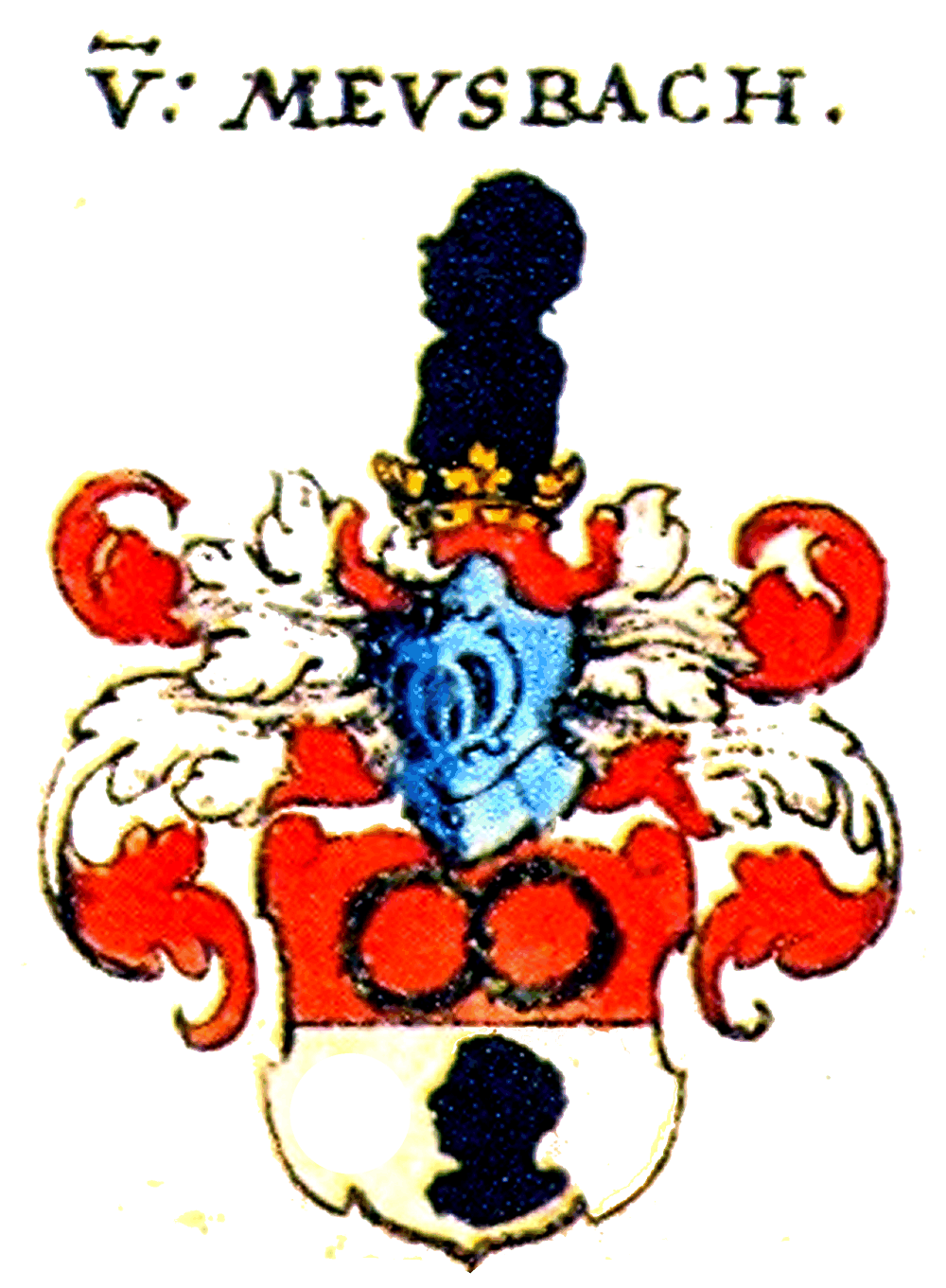
The arms as engraved in Siebmacher's Wappenbuch of 1605 (public domain), the plate captioned "V: Mevsbach"; the shield is divided red over silver, with two wreaths in the chief and a Moor's head in the base, and the crest a demi-Moor from a crowned helm.
Blazon — Per fess Gules and Argent; in chief two wreaths Vert side by side; in base a Moor's head reversed.
Crest — On a crowned helm, a demi-Moor reversed; mantling Gules and Argent.
Motto — Tenax Propositi
Born Otfried Hans Freiherr von Meusebach (1812–1897), a Prussian baron who on arrival in Texas put aside his title of nobility and adopted the name John O. Meusebach. He succeeded Prince Carl of Solms-Braunfels as commissioner-general of the Adelsverein, the German emigration society, and directed its colony from New Braunfels from 1845 to 1847; in 1847 he made the treaty with the Penateka Comanche that bears his name. In 1846 he founded Fredericksburg, in Gillespie County — outside this Roll's ground, and recorded here only for completeness. He sat in the Senate of Texas in 1851–53 for the district of Bexar, Comal and Medina, his home listed as New Braunfels in Comal County; the family home stood there until a tornado destroyed it on 12 September 1869. His arms are his family's, as recorded in Siebmacher's Wappenbuch of 1605 and in Zedlitz-Neukirch's Neues Preussisches Adels-Lexicon (1836); his motto, Tenax Propositi — steadfast in purpose — is remarked in the Handbook of Texas. Entered under this Roll's rule for the neighbouring counties (Comal). Recorded here for identification; this entry implies no affiliation with, and no endorsement by, the family of Meusebach.
Prince Carl of Solms-Braunfels
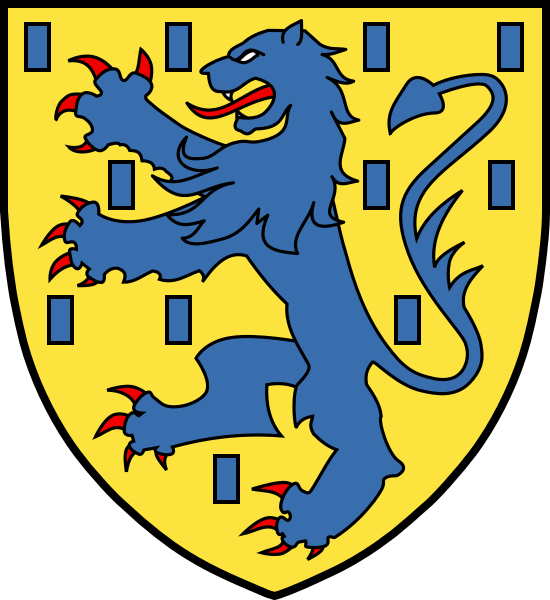
The house arms — a blue lion on gold strewn with blue billets — as depicted on Wikimedia Commons (CC BY-SA 3.0).
Blazon — Or semy of billets Azure, a lion rampant Azure.
Crest — A lion Azure sejant affronty in a vol per fess Gules and Or.
Carl, Prince of Solms-Braunfels (1812–1875), first commissioner-general of the Adelsverein, the German emigration society. He bought the tract on the Guadalupe and Comal rivers from Juan Martín Veramendi and Raphael C. Garza, and on Good Friday, 21 March 1845, founded New Braunfels at its head, naming it for Braunfels, his ancestral castle on the Lahn; there he laid out the Zinkenburg stockade and the Sophienburg fort. His time in Texas was brief — some ten months in all, about two of them at New Braunfels — and he sailed for Germany on 15 May 1845 and never returned; the colony was carried on by John O. Meusebach, entered above. The arms are the house arms of Solms-Braunfels, the blue lion on gold strewn with blue billets, borne as the centre shield of the princely arms; they are not the differenced civic arms of the town of Braunfels. New Braunfels High School's unicorn mascot, adopted in 1928, descends from a misreading of these arms — the beast is a lion, not a unicorn. Entered under this Roll's rule for the neighbouring counties (Comal). Recorded here for identification; this entry implies no affiliation with, and no endorsement by, the House of Solms-Braunfels.
Ernst, Count von Coreth
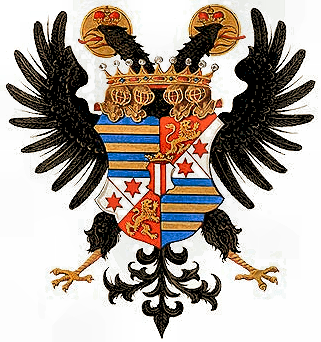
The arms of the Counts Coreth zu Coredo und Starkenberg of 1766 and 1772 — the quarterly shield on the breast of a black double-headed eagle, four gold helms and a count's crown above — as engraved in Conrad Tyroff's Wappen aller fürstlichen und gräflichen Häuser der österreichischen Monarchie (Nuremberg, 1853), vol. 3, plate 39 (depiction via Wikimedia Commons, public domain).
Blazon — Quarterly: first and fourth, Azure, three bars Or; second, per bend sinister, dexter Gules a lion reversed Or, sinister Argent divided per bend, in each division an eight-pointed star Gules; third, as the second reversed, the stars in dexter and the lion in sinister; overall an inescutcheon paly of four Gules and Argent, ensigned with a count's crown. (After Tyroff's description of the counts' arms of 1766, the arms recorded for the family in Siebmacher's Wappenbuch, vol. 4, Tirol (1859), p. 4, and in Spreti's Enciclopedia Storico-Nobiliare Italiana, vol. II.)
Ernst Ignaz Franz, Graf von Coreth zu Coredo und Starkenberg (1803–1881), born at Vienna on 2 December 1803, a son of Graf Franz Joseph, who fell at Austerlitz in 1805; an officer of the Austrian army from 1820 to 1830. He came to Texas with his wife Agnes, née Erler, and their six children in the fall of 1846, on the ship York out of Antwerp, and farmed at New Braunfels in Comal County. In late 1847 he bought from John O. Meusebach, entered above, the 280-acre tract on Dry Comal Creek that Meusebach had chosen for himself — house, cabins, fences and ploughed land, for $3,266 — and lived on it the rest of his life. In 1852 his eldest daughter Agnes married Meusebach. His family, a Tyrolean house of the Val di Non seated at Castel Coredo, has two lines from the same castle: the counts' line, Coreth zu Coredo, Freiherren zu Starkenberg, raised to counts of the Empire in 1766 and to hereditary counts on 26 April 1772, and the barons' line, Coreth zu Coredo und Rumo (1745), whose shield bears Castel Coredo itself. Ernst descends in the counts' line, and the arms entered here are the counts' arms; the barons' arms are not his. In the full achievement the shield stands on the breast of a black double-headed eagle, beneath four helms and a count's crown; the armorial texts describe no individual devices for the four helms, and no crest is recorded here. The record is not perfectly consistent in detail: Tyroff and Siebmacher divide the second and third quarters per bend, as the depiction shows, while Spreti divides them per fess, and the plate draws the stars with six points where Tyroff's text says eight-pointed; text and depiction are recorded as they stand. Entered under this Roll's rule for the neighbouring counties (Comal). Recorded here for identification; this entry implies no affiliation with, and no endorsement by, the family of Coreth.
Gustavo García-Siller
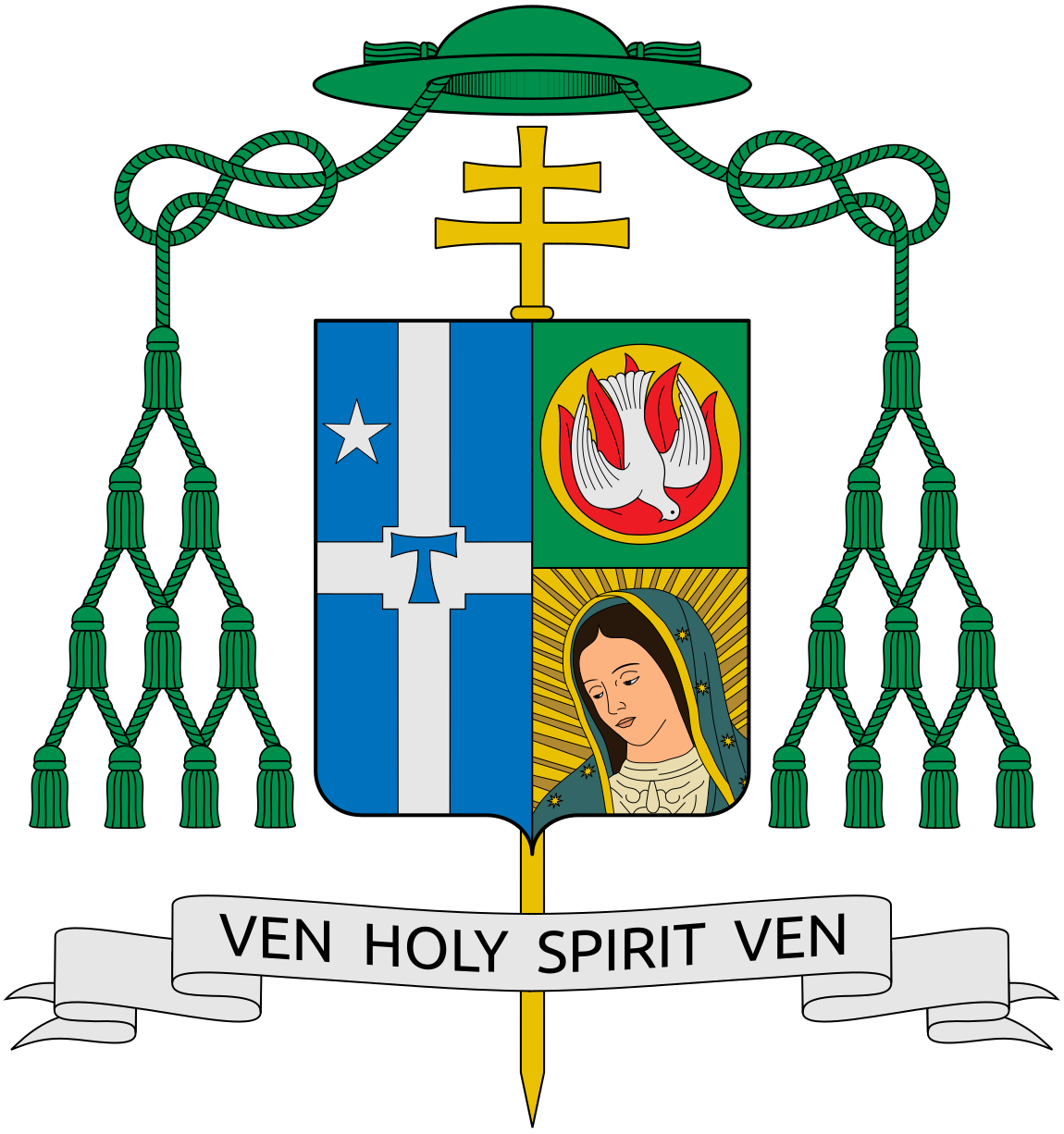
The personal arms of the Archbishop impaled with those of the Archdiocese, as depicted on Wikimedia Commons (depiction by SajoR, CC BY-SA 2.5).
Blazon — Impaled: dexter, the arms of the Archdiocese of San Antonio (Azure, on a cross quadrate Argent a Tau-cross of the first, in dexter chief a star of the second); sinister, per fess: in chief Vert, the Holy Spirit in the form of a dove descending Argent within a roundel Or charged with flames Gules; in base, Our Lady of Guadalupe upon a glory Or. Behind the shield an archiepiscopal cross Or; above, a green galero with ten tassels on either side. (Blazon rendered descriptively from the published depiction.)
Motto — Ven Holy Spirit Ven
The personal arms of Gustavo García-Siller, a Missionary of the Holy Spirit, Archbishop of San Antonio since 2010, impaled with the arms of his archdiocese as is customary for a diocesan bishop. The dove and flames are the Holy Spirit of his congregation and his motto; Our Lady of Guadalupe is the patroness of Mexico, his native country, and of the Americas. Recorded here for identification; this entry implies no affiliation with, and no endorsement by, Archbishop García-Siller or the Archdiocese of San Antonio.
José H. Gómez
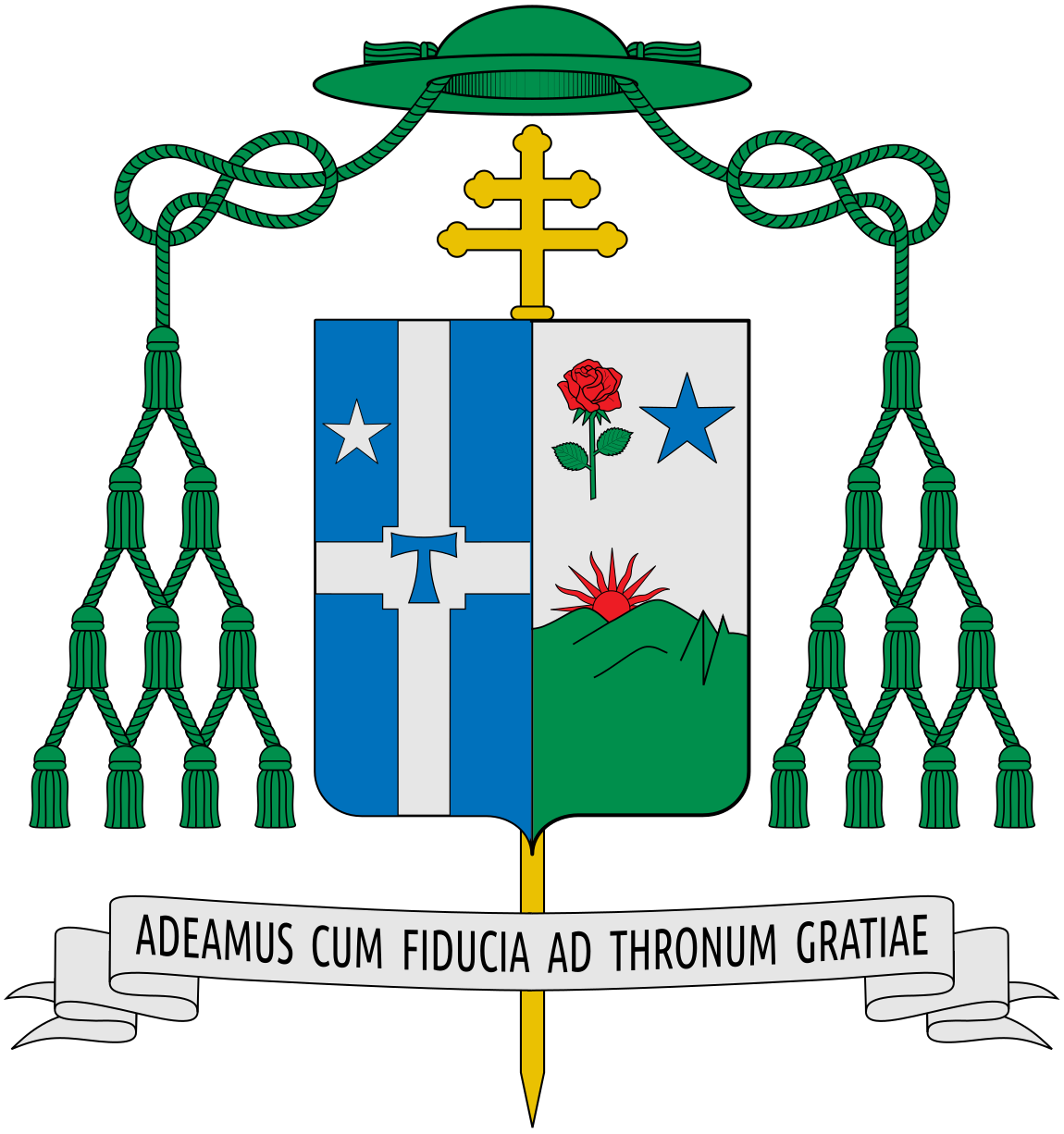
The personal arms of Archbishop Gómez impaled with those of the Archdiocese of San Antonio, in the depiction of SajoR (CC BY-SA 2.5): his published Los Angeles achievement, with the dexter half replaced by the arms of the Archdiocese of San Antonio from SajoR's depiction of Archbishop García-Siller's arms — the substitution made by this College.
Blazon — Impaled: dexter, the arms of the Archdiocese of San Antonio (Azure, on a cross quadrate Argent a Tau-cross of the first, in dexter chief a star of the second); sinister, the personal arms of Archbishop Gómez, as recorded: Argent, issuant from base a mountain Vert with a sun issuant Gules; to chief dexter a rose blossom in profile of the third, stemmed and leafed of the second, and to chief sinister a star Azure. Behind the shield an archiepiscopal cross Or; above, a green galero with ten tassels on either side.
Motto — Adeamus cum fiducia ad thronum gratiae
The personal arms of José Horacio Gómez, born at Monterrey, Mexico, on 26 December 1951, appointed Archbishop of San Antonio on 29 December 2004 and translated to Los Angeles as coadjutor in April 2010, succeeding there on 1 March 2011. His personal arms date from his consecration as an auxiliary bishop of Denver in 2001, and he bears them still, now impaled with the arms of Los Angeles; they are shown here as he bore them in San Antonio, impaled with the Archdiocese's. The silver field, green mountain and rising red sun are taken from the arms of Monterrey, his birthplace; the rose is Our Lady of Guadalupe, patroness of the Americas; the blue star is Mary, Star of the New Evangelization, and Texas, his home for more than twenty years. The motto is Hebrews 4:16: 'Let us confidently approach the throne of grace.' Recorded here for identification; this entry implies no affiliation with, and no endorsement by, Archbishop Gómez or the Archdiocese of Los Angeles.
Michael Joseph Boulette
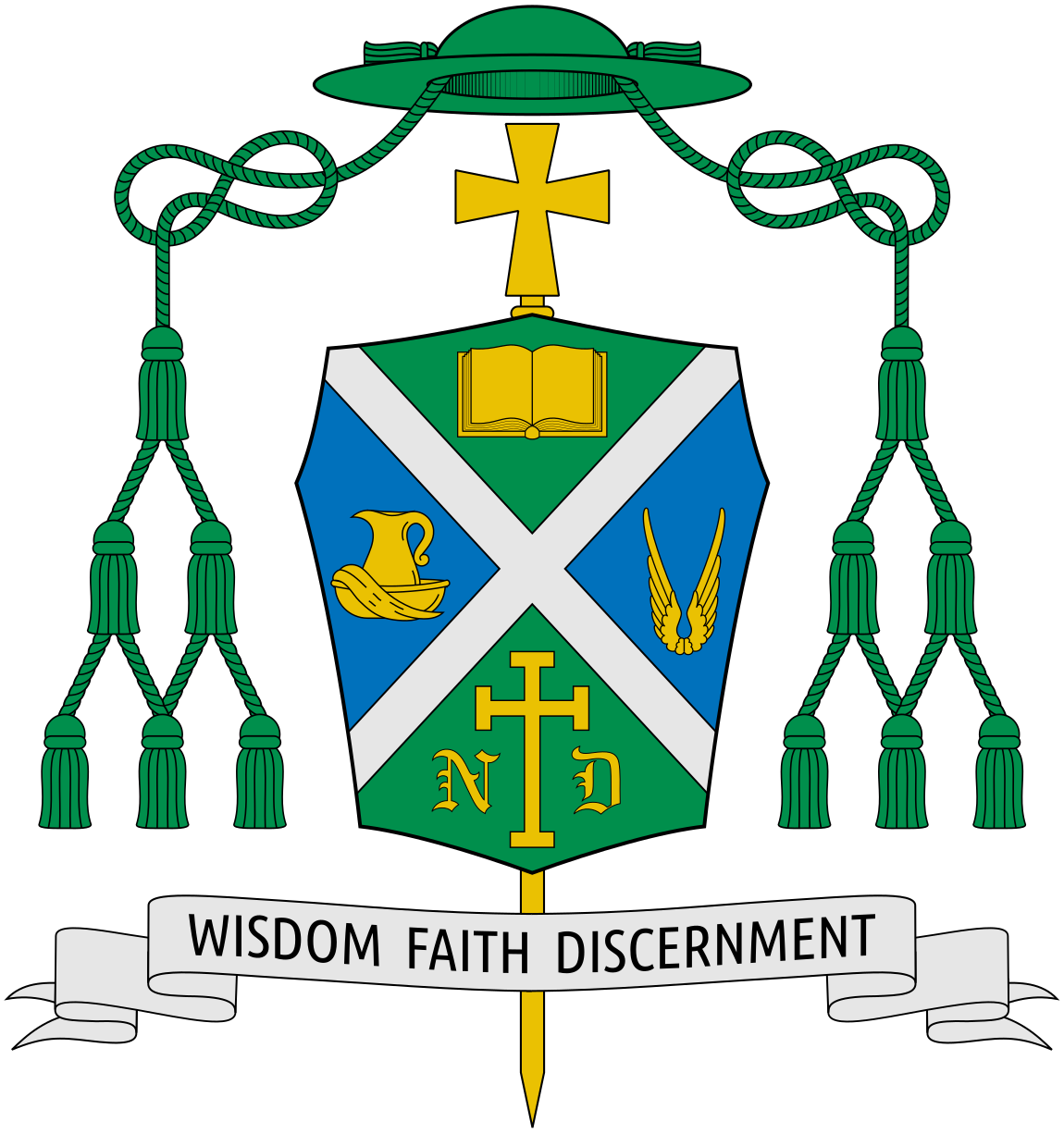
The personal arms of Bishop Boulette, as depicted on Wikimedia Commons (depiction by SajoR, CC BY-SA 2.5); the published depiction misletters the motto as “DISCERNMENTE” — the stray final letter is removed in the College's copy.
Blazon — Per saltire Vert and Azure, a saltire Argent between: in chief an open book Or; in the dexter flank a ewer above a basin Or; in the sinister flank a pair of wings conjoined Or; in base a tau cross Or between the letters N and D Or. Behind the shield a processional cross Or; above, a green galero with six tassels on either side. (Blazon rendered descriptively from the published depiction.)
Motto — Wisdom Faith Discernment
The personal arms of Michael Joseph Boulette, auxiliary bishop of San Antonio since 2017. Recorded here for identification; this entry implies no affiliation with, and no endorsement by, Bishop Boulette or the Archdiocese of San Antonio.
José Arturo Cepeda Escobedo
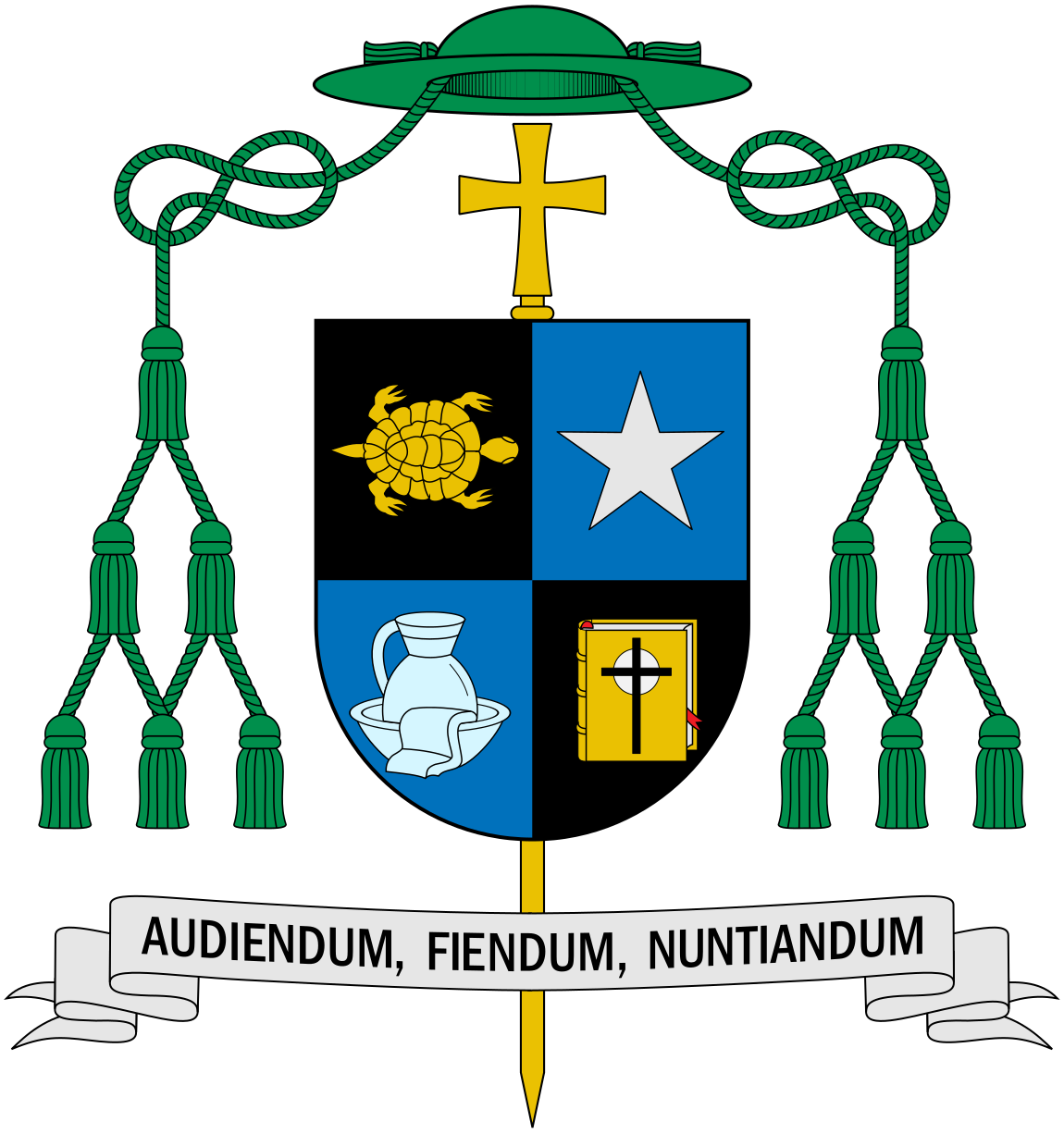
The personal arms of Bishop Cepeda, as depicted on Wikimedia Commons (depiction by SajoR, CC BY-SA 2.5).
Blazon — Quarterly Sable and Azure: in the first quarter a tortoise Or; in the second a mullet Argent; in the third a ewer and basin with a towel Argent; in the fourth a closed book Or charged with a cross Sable. Behind the shield a processional cross Or; above, a green galero with six tassels on either side. (Blazon rendered descriptively from the published depiction.)
Motto — Audiendum, Fiendum, Nuntiandum
The personal arms of José Arturo Cepeda Escobedo, auxiliary bishop of San Antonio, formerly auxiliary bishop of Detroit, where these arms were first borne. Recorded here for identification; this entry implies no affiliation with, and no endorsement by, Bishop Cepeda or the Archdiocese of San Antonio.
Gary Wayne Janak
The personal arms of Bishop Janak, as depicted on Wikimedia Commons (depiction by SajoR, CC BY-SA 2.5).
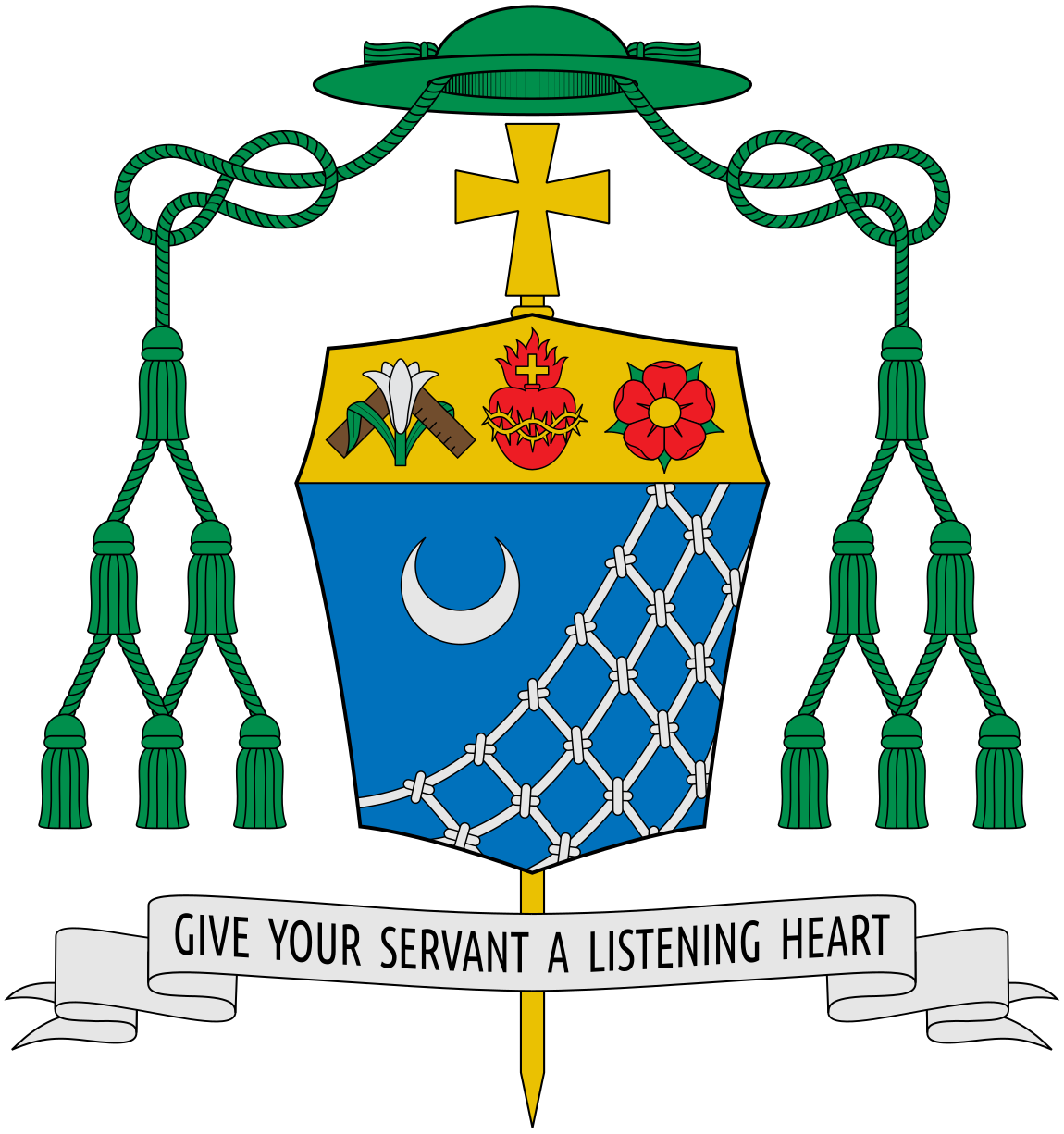
Blazon — Azure: in dexter a crescent Argent, in sinister fretty Argent; on a chief Or, the Sacred Heart Gules, crowned with a cross and encircled by a crown of thorns, between a lily Argent above crossed logs and a rose Gules. Behind the shield a processional cross Or; above, a green galero with six tassels on either side. (Blazon rendered descriptively from the published depiction.)
Motto — Give Your Servant a Listening Heart
The personal arms of Gary Wayne Janak, auxiliary bishop of San Antonio since 2021. His motto is Solomon's prayer (1 Kings 3:9). Recorded here for identification; this entry implies no affiliation with, and no endorsement by, Bishop Janak or the Archdiocese of San Antonio.
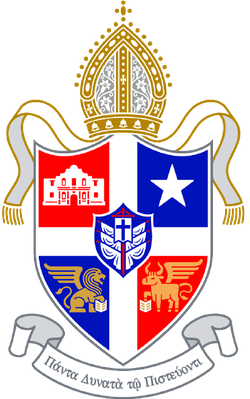
Blazon — Quarterly Gules and Azure, a cross throughout Argent between: in the first quarter a representation of the Alamo Argent; in the second a mullet Argent; in the third the lion of Saint Mark Or; in the fourth the bull of Saint Luke Or; overall an escutcheon Azure bearing a trophy of six flags and a dovetailed banner Argent charged with a cross Gules. The shield is ensigned with a bishop's mitre, and below it a scroll bears the motto. (Blazon rendered from the diocese's own account of its shield and the description at Heraldry of the World.)
Motto — Πάντα δυνατὰ τῷ πιστεύοντι — Everything is possible to one who has faith (Mark 9:23)
The Episcopal diocese formed in 1874 as the Missionary District of Western Texas and erected a diocese in 1904; its see city is San Antonio and its territory includes Bexar County. Its shield was designed by the Reverend Louis A. Parker and adopted in 1927: the Alamo, cradle of Texas liberty; the star, for the Lone Star of Texas and the star of Bethlehem; the winged lion of Saint Mark; and the winged ox of Saint Luke; the six flags of the central escutcheon are the six flags over Texas, the Church's banner the seventh. The depiction shown is the diocese's arms as published; the College's own standard rendering may replace it in time. Recorded for identification; this entry implies no affiliation with, and no endorsement by, the Diocese of West Texas.
Order of the Alamo
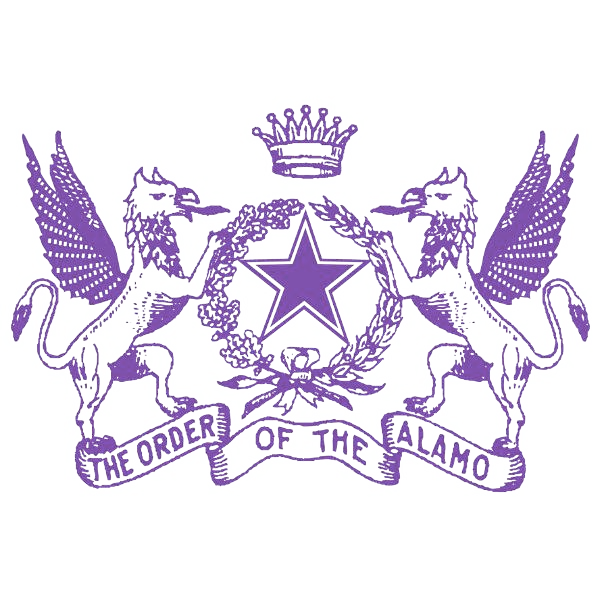
The Order's device as used by the Order, in the Order's purple: two griffins supporting a laurel wreath around a star, a crown above, and the Order's name on a scroll below (artwork via the Fiesta San Antonio Commission; the same device, in the Order's purple, heads the Order's own website).
Founded in 1909 by John B. Carrington — the Order's own website gives its incorporation as 1912; other accounts give 1915 — the Order is, in its own words, a private club for men and women dedicated to the preservation of the Alamo and to the collection of materials relating to Texas history. Each April it stages the Coronation of the Queen of Fiesta at the Majestic Theatre, one of the oldest ceremonies of Fiesta; the Queen's court comprises a princess and twenty-four duchesses. The Order's device is heraldic in form though it bears no shield: two griffins rampant as supporters, upholding a laurel wreath within which is a single star — the Lone Star — a crown above the wreath for the Queen the Order crowns, and below a scroll inscribed THE ORDER OF THE ALAMO. Recorded here for identification; this entry implies no affiliation with, and no endorsement by, the Order of the Alamo.
Equestrian Order of the Holy Sepulchre of Jerusalem
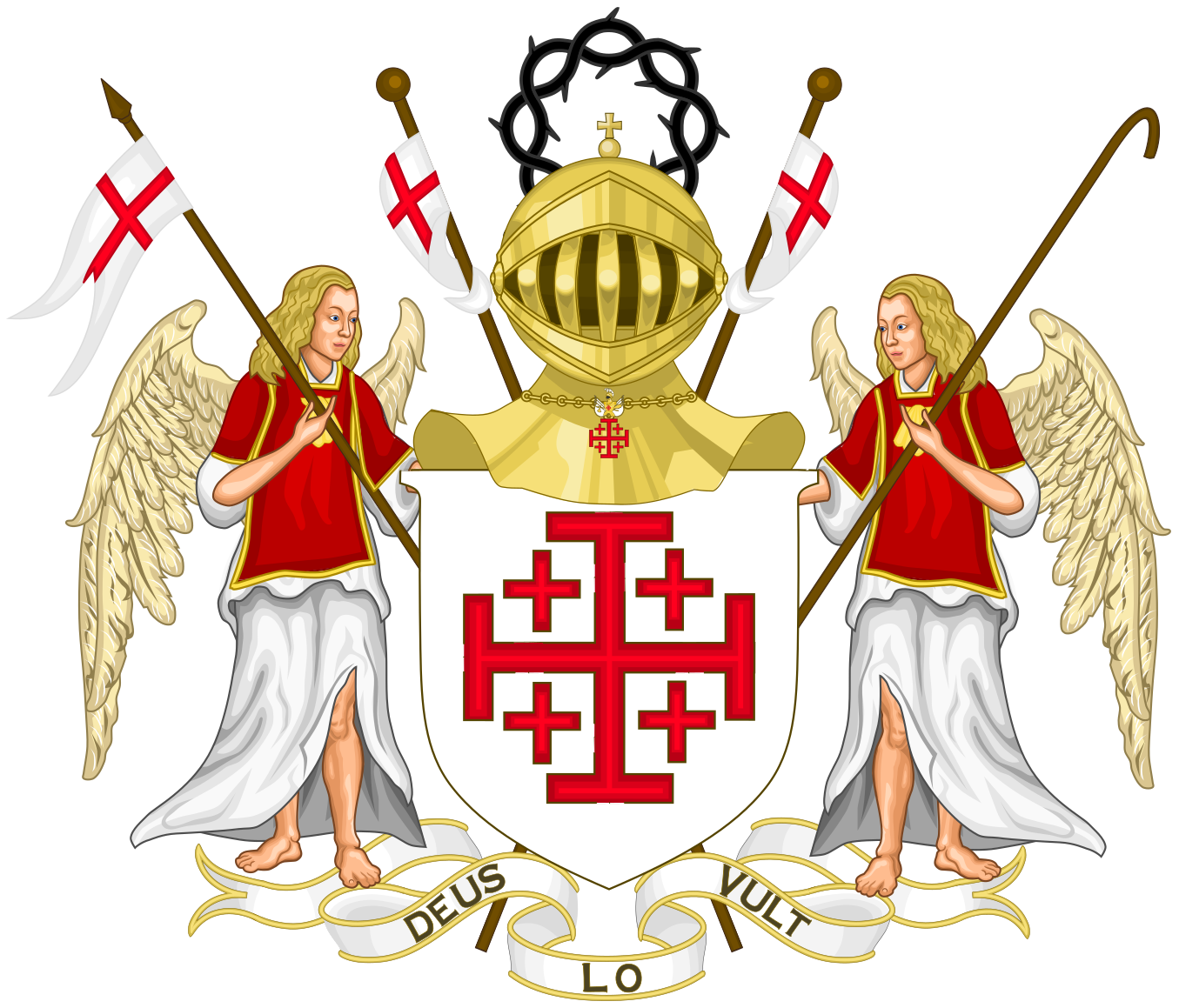
The arms of the Order in their full achievement — the red Jerusalem cross on its silver shield, a gold helmet with the Crown of Thorns above, two angels in red dalmatics as supporters, and the motto on its scroll below — as depicted on Wikimedia Commons (depiction by Mathieu Chaine, CC BY-SA).
Blazon — Argent, a cross potent between four crosslets Gules. (The arms attributed to the Latin Kingdom of Jerusalem, borne by the Order with the Jerusalem cross enamelled in red — the colour of blood, for the five wounds of Christ — as the Order's own accounts of its arms describe them.)
Motto — Deus lo vult
A Catholic order of knighthood under the protection of the Holy See, charged with supporting the Christian presence in the Holy Land. Its Southwestern Lieutenancy — covering Texas, Oklahoma, Arkansas and New Mexico — keeps an Archdiocese of San Antonio Section, whose representatives are Sir David and Dame Janet Pollock; San Antonio is typically the lieutenancy's second-largest city contingent after Houston, and the lieutenancy's annual investiture weekend was held in San Antonio on 5–7 September 2025, with the Investiture Mass at San Fernando Cathedral. In the full achievement, two white standards bearing the red cross flank the helmet, and the two angel supporters stand for the Order's crusading and pilgrim natures. Recorded here for identification; this entry implies no affiliation with, and no endorsement by, the Equestrian Order of the Holy Sepulchre of Jerusalem.
Order of Malta
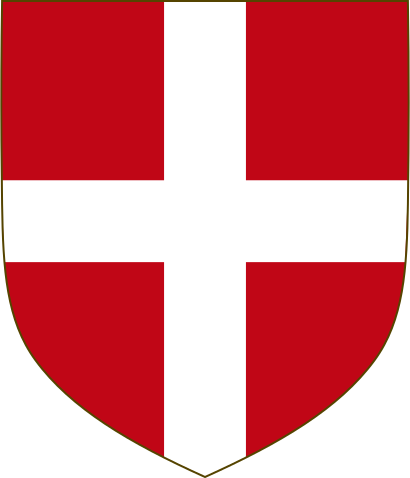
The shield of the Order — a plain white cross on red — as depicted on Wikimedia Commons (depiction by Constantine Plakidas).
Blazon — Gules, a cross Argent. (The plain white Latin cross on a red field, granted to the Knights Hospitaller in 1130 to distinguish them from the Templars. The Order's eight-pointed white cross is its badge, borne among other places on the flag of its works; it is not the shield.)
The Sovereign Military Hospitaller Order of Saint John of Jerusalem, of Rhodes and of Malta — the Knights Hospitaller, recognised in 1113, sovereign in Rhodes and afterwards in Malta, and today a sovereign subject of international law headquartered in Rome, devoted to the care of the sick and the poor. In the United States, its Federal Association keeps three Texas regions, of which one is the joint Austin/San Antonio Region — a shared regional presence across the two cities, recorded here exactly as such, not as a San Antonio house. Recorded here for identification; this entry implies no affiliation with, and no endorsement by, the Sovereign Military Order of Malta.
Texas Cavaliers
The Cavaliers' organizational badge as displayed on their own site, texascavaliers.org: a mounted cavalier within a red-bordered shield, a star above, and a scroll below inscribed TEXAS CAVALIERS.
A San Antonio civic organization founded in 1926, whose members choose King Antonio each year and whose River Parade raises money for children's charities in Bexar County through the Texas Cavaliers Charitable Foundation. The Cavaliers bear no arms of record and publish no blazon; the device shown is their organizational badge, not a coat of arms, recorded here for identification. This entry implies no affiliation with, and no endorsement by, the Texas Cavaliers.
141st Infantry Regiment
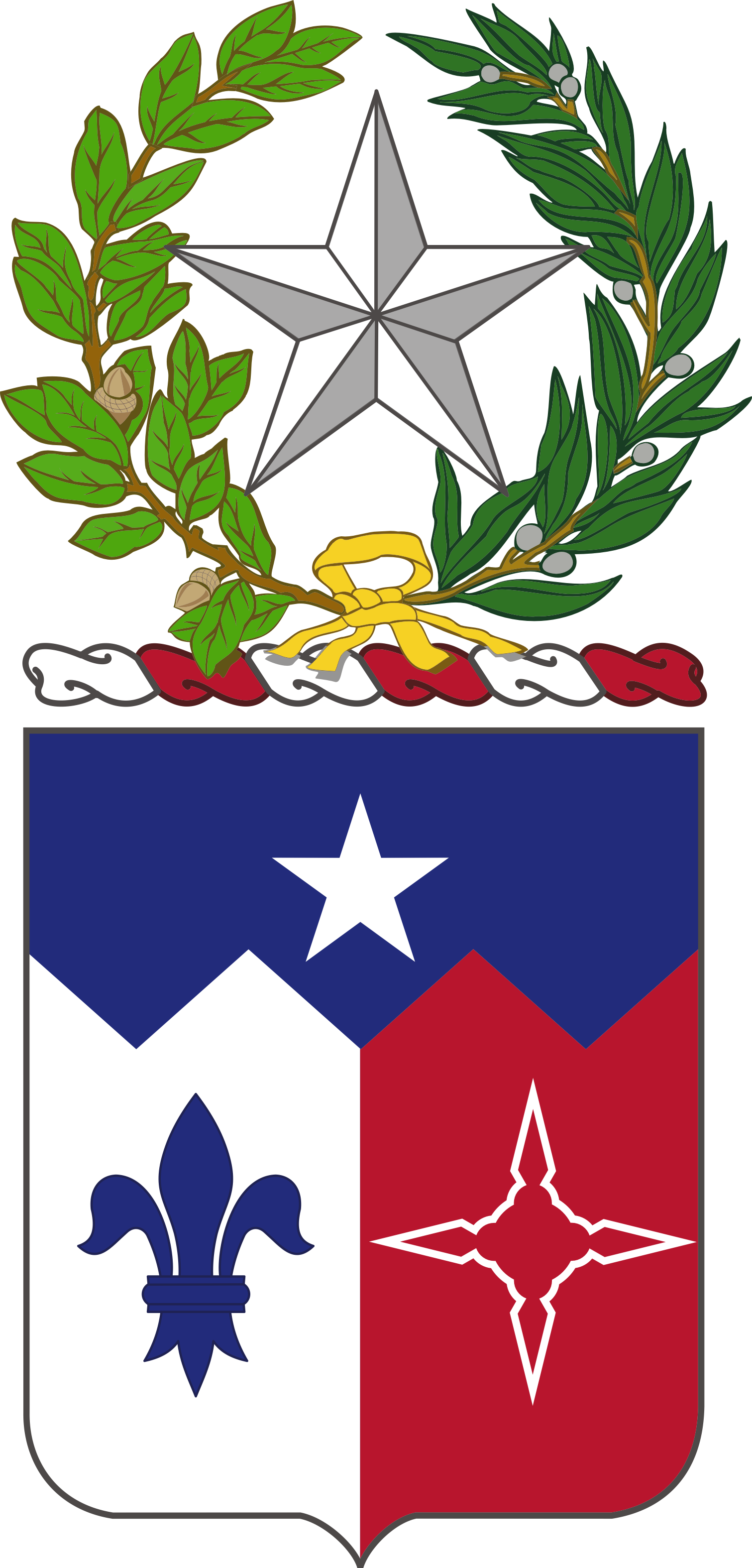
The regiment's coat of arms as drawn by the U.S. Army Institute of Heraldry (public domain).
Blazon — Per pale Argent and Gules, a fleur-de-lis Azure and the badge of the 3d Brigade, 1st Division, 4th Army Corps, during the Spanish-American War, Proper fimbriated of the first; on a chief dancetté of the third a mullet of the fifth. (Blazon of the U.S. Army Institute of Heraldry, quoted verbatim; the arms were approved 5 March 1931.)
Crest — That for the regiments and separate battalions of the Texas Army National Guard: on a wreath of the colors Argent and Gules, a mullet Argent encircled by a garland of live oak and olive Proper.
Motto — Remember the Alamo
The 'First Texas' — the oldest regiment of the Texas Army National Guard, its lineage recognized by the U.S. Army Center of Military History from 18 February 1823, and its senior company descending from the Washington Guards of 1836. It is a Bexar regiment: the Alamo Rifles of Béxar stand among the companies of its lineage from 1873; its headquarters has been at San Antonio since 1933; and its 1st Battalion — 'Task Force Alamo' — is headquartered in San Antonio today, in the 72nd Infantry Brigade Combat Team of the 36th Infantry Division. The shield's colours and star are those of the flag of the Texas Republic; the fleur-de-lis is for France in the First World War, and the corps badge for the Cuban occupation of 1898. Its colours carry the streamers Republic of Texas, The Alamo, and San Jacinto. Recorded here for identification; this entry implies no affiliation with, and no endorsement by, the Regiment, the Texas Military Department, or the U.S. Army.
U.S. Army North (Fifth Army)
Shoulder sleeve insignia of U.S. Army North, as approved by the U.S. Army Institute of Heraldry (public domain).
Blazon — No coat of arms was ever approved for this command; it bore insignia only. Shoulder sleeve insignia, as recorded by the U.S. Army Institute of Heraldry: On a red rectangular background with top corners chamfered at 45°, a silhouette of a mosque in blue charged with a white letter "A" above a white number "5". Its distinctive unit insignia: a silver Florentine fleur-de-lis garnished with red buds, over its centre a blue mosque tower, with five stars positioned in the form of a "V".
Motto — Strength of the Nation!
The United States Fifth Army, activated at Oujda, Morocco, on 5 January 1943 under Lieutenant General Mark W. Clark — the first American field army activated overseas — and the army of Salerno, Anzio and the liberation of Rome. Its headquarters came to Fort Sam Houston in June 1971, succeeding the Fourth Army in the Quadrangle, and San Antonio was its home for the rest of its life. As U.S. Army North it was the Army component of U.S. Northern Command, charged with homeland defense and defense support of civil authorities. The mosque in its insignia is Morocco, where it was born; the fleur-de-lis of its distinctive insignia is Florence, for its service in Italy, and its five stars are its five Italian campaigns. The command cased its colors at Fort Sam Houston on 15 July 2026, its missions passing to the U.S. Army Western Hemisphere Command. Recorded here for identification; this entry implies no affiliation with, and no endorsement by, the United States Army.
U.S. Army South (Sixth Army)
Distinctive unit insignia of U.S. Army South, as approved by the U.S. Army Institute of Heraldry (public domain).
Blazon — No coat of arms was ever approved for this command; it bore insignia only. Shoulder sleeve insignia, as recorded by the U.S. Army Institute of Heraldry: on an ultramarine blue disc, a white galleon with a red cross on the sail, riding on white wave lines. Its distinctive unit insignia: a rectangle arced at top and bottom divided saltirewise gold and red and bearing a stylized blue "S"; overall a white Spanish galleon charged on the upper fore-topsail with a red cross formy, all enclosed at the bottom by a gold scroll inscribed "DEFENSE AND FRATERNITY".
Motto — Defense and Fraternity
The Army service component command of U.S. Southern Command — the Army of the Panama Canal, of Operation Just Cause, and of partnership with the armies of Latin America and the Caribbean. Its headquarters came to Fort Sam Houston in 2002–03, into the old Brooke Army Medical Center building, and San Antonio was its home for the rest of its life. In 2008 it was consolidated with the Sixth United States Army, the Pacific army of New Guinea, Leyte and Luzon, and by special exception kept its own Spanish galleon — the ship of the Caribbean in the days of the Spanish regime, its sail bearing the cross of Columbus — a device with a natural resonance in Béxar. The command cased its colors at Trinity University on 29 May 2026, its missions passing to the U.S. Army Western Hemisphere Command. Recorded here for identification; this entry implies no affiliation with, and no endorsement by, the United States Army.
Army Medical Department Regiment
Blazon — Per pale; to dexter, paly of thirteen Gules and Argent, on a chief Azure, twenty mullets in four rows of five each of the second: to sinister, Argent, a staff entwined with a serpent Vert. (Blazon of the U.S. Army Institute of Heraldry, quoted verbatim; the current design was approved 31 October 2014, rescinding the design approved 17 April 1986.)
Crest — From a wreath Argent and Azure, upon a mound Argent (Silver Gray), a cock reguardant Proper. (On the regimental flag the arms are displayed on the breast of a displayed eagle, the crest above the eagle's head; the flag's background is maroon and its fringe white.)
Motto — Experientia et Progressus
The regiment of all Army medicine — the AMEDD. Its arms rest on a device probably first used in 1818, the year Congress made the Medical Department permanent: the twenty stars are the twenty states of 1818 and the stripes are the flag's; the green staff entwined with a serpent is the rod of Aesculapius, green being the Medical Corps colour of the nineteenth century, and the cock of the crest is Aesculapius's bird. Devised in their present line about 1863 under Surgeon General William Alexander Hammond, they are among the oldest regimental emblems in the Army. Fort Sam Houston is the Regiment's home by Headquarters, Department of the Army General Order 27 of 30 June 1986, and the Regiment Office stands at Joint Base San Antonio–Fort Sam Houston today. The motto is 'Experience and Progress.' The current arms date from 2014; the Institute's published drawing still shows the crest that design superseded, so this entry stands on the recorded blazon and crest until the College's own depiction is made. Recorded here for identification; this entry implies no affiliation with, and no endorsement by, the Regiment or the United States Army.
Air Education and Training Command
The command's emblem as approved through Air Force heraldry (public domain).
Blazon — Azure, in front of a pair of stylized wings displayed Or a five-pointed star in flat perspective Argent pierced by a torch of the second flamant Gules, all within a diminished bordure of the second. Attached below the shield, a White scroll edged with a narrow Yellow border and inscribed 'AIR EDUCATION & TRAINING COMMAND' in Blue letters. (Emblem blazon as recorded by the U.S. Army Institute of Heraldry, quoted verbatim.)
Crest — An eagle, a cloud formation, and an heraldic wreath — so AETC Instruction 84-101 describes the crest of the command's coat of arms; the emblem in general use is the coat of arms without the crest.
The Air Force's training command — 'The First Command' — established and activated in January 1942, the oldest major command in the Air Force, with headquarters at Randolph since 1957, today Joint Base San Antonio–Randolph. The device was approved as a shoulder patch on 4 October 1949 and as an emblem on 20 July 1953 for the Air Training Command, and was retained when the command was redesignated Air Education and Training Command on 1 July 1993. Every Airman begins in this command, and much of that training is in Bexar County. Recorded here for identification; this entry implies no affiliation with, and no endorsement by, the United States Air Force.
37th Training Wing
The wing's emblem as approved through Air Force heraldry (public domain).
Blazon — Azure, a saltire within a diminished border Or. Attached below the shield, a White scroll edged with a narrow Yellow border and inscribed '37 TRAINING WING' in Blue letters. (Emblem blazon of the Air Force Historical Research Agency, quoted verbatim.)
The host wing at Joint Base San Antonio–Lackland since 1 July 1993 and the largest training wing in the Air Force — the 'Gateway to the Air Force,' conducting all enlisted basic military training. The saltire is the crossroads: the honours of the 37th Pursuit Group, the Second World War 'Defenders of the Crossroads' of the Panama Canal, whose insignia the Air Force authorized the Wing to adopt in 1953. The emblem was approved for the Group on 23 June 1941 and for the Wing on 4 August 1953, reinstated 10 March 1992, and its newest rendition approved 28 March 2013. Recorded here for identification; this entry implies no affiliation with, and no endorsement by, the United States Air Force.
502d Air Base Wing
The wing's emblem as approved through Air Force heraldry (public domain).
Blazon — Per pale Azure and Vert a nebulee palewise Or, issuant at nombril a mullet couped Gules, surmounted by a second mullet Argent inner fimbriation of the first; all within a diminished bordure Or. Attached below the shield, a White scroll edged with a narrow Yellow border and inscribed '502D AIR BASE WING' in Blue letters. (Emblem blazon of the Air Force Historical Research Agency, quoted verbatim; the U.S. Army Institute of Heraldry carries the same wording for the wing's groups.)
The host wing for the whole of Joint Base San Antonio, activated at Fort Sam Houston on 1 August 2009 and headquartered there, beside the Quadrangle; it took host responsibility at Lackland and Randolph in 2010. The design's roots are in the wing's first official emblem, approved 8 July 1954: the divided shield is earth and sky, and the lone star — its three visible points the Air Force, the Army and the Navy in joint venture — pictures the joint-base mission. The recorded blazon divides the shield per pale, but the wing's official drawing — the same artwork it bears on its headquarters sign — divides it per fess nebuly, blue over green; the inconsistency stands in the official record itself, and both text and drawing are recorded here as they stand. Recorded here for identification; this entry implies no affiliation with, and no endorsement by, the United States Air Force.
San Antonio German Club
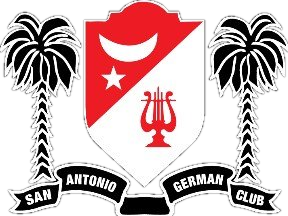
The club's arms as used by the club, with its palm-tree supporters and name scroll.
Blazon — Per bend sinister Gules and Argent: in the Gules a crescent and a mullet Argent; in the Argent a lyre Gules. The shield is flanked by two palm trees, and below it a scroll is inscribed SAN ANTONIO GERMAN CLUB. (Blazon rendered descriptively from the club's depiction.)
The arms of the German club of San Antonio, from the city's German-Texan community: the crescent and star on the red field, and a lyre in base for German song, the whole flanked by two palm trees — a Texas flourish on a German shield. Recorded here for identification; this entry implies no affiliation with, and no endorsement by, the club.
Canary Islands Descendants Association
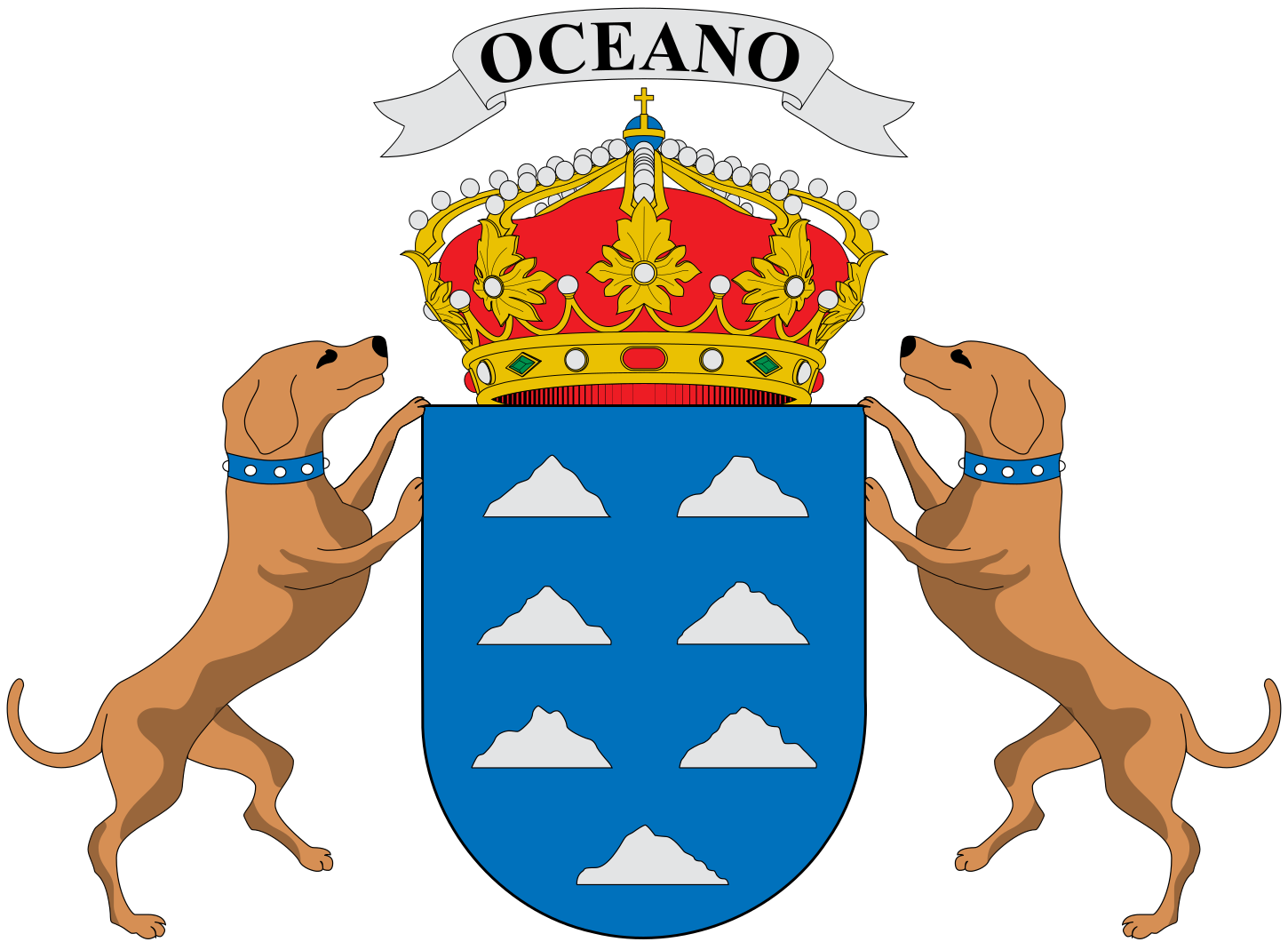
The arms of the Canary Islands, borne at the centre of the Association's seal — as depicted on Wikimedia Commons (public domain).
Blazon — Azure, seven islands Argent, well ordered, two, two, two and one in base; the shield ensigned with the royal crown of Spain, supported by two dogs proper, collared, and beneath a scroll Argent inscribed OCÉANO. (The arms of the Canary Islands, as set by the Statute of Autonomy of the Canary Islands, 1982 — borne entire at the centre of the Association's seal, whose legend reads CANARY ISLANDS DESCENDANTS ASSOCIATION, SAN ANTONIO, TEXAS, with the date MARCH 9, 1731 below.)
Motto — Océano
The association of the descendants of the Canary Island families — sixteen families in all — who came to San Fernando de Béxar on 9 March 1731 and founded the Villa de San Fernando, the first regularly organized civil government in Texas; at its first election, 1 August 1731, Juan Leal Goraz was chosen alcalde. Before their departure, the Crown had granted the settler families the status of hidalgos. The association's seal adopts the arms of the founders' homeland entire, and dates itself by the landing; this Roll shows the arms themselves, as borne at the seal's centre. The founders' church, San Fernando, raised on the plaza laid out with the villa, is today the cathedral of the Archdiocese of San Antonio, entered above. Recorded here for identification; this entry implies no affiliation with, and no endorsement by, the Association.
The Isleño Founders of San Fernando de Béxar
The sixteen Canary Island families who founded the Villa de San Fernando in 1731, entered here as a body, for the honour that is documented for them: by the Real Despacho of 14 February 1729 the Crown granted the settler families the status of hidalgos — hijosdalgo de solar conocido — a rank their descendants in Bexar have kept in memory ever since. No arms are documented for any founding family: no grant, certification, or armorial entry ties a coat to any of their San Antonio lines, and this Roll records none for them. The achievement printed for one family — Travieso, on the cover of The Travieso Family Papers (Los Bexareños, 2008): Gules, a fleur-de-lis Or upon an ermine base, with helm, mantling, and a crest of plumes — is a modern assumption, not a record; a Spanish surname blazon for Travieso (Gules, a mount Argent topped by a fleur-de-lis Or) does stand in the armorials, but it belongs to peninsular lines and proves nothing for this one. The arms of the founders' homeland are borne in Bexar today in the seal of the Canary Islands Descendants Association, entered above. The sixteen, in the order of the Cuautitlán list of 8 November 1730, with home islands as the record gives them: Juan Leal Goraz (Lanzarote); Juan Curbelo (Lanzarote); Juan Leal, called el Mozo (Lanzarote); Antonio de los Santos (Lanzarote); Joseph Padrón (La Palma); Manuel de Niz (Gran Canaria); Vicente Álvarez Travieso (Tenerife); Salvador Rodríguez; Francisco de Arocha (La Palma); Antonio Rodríguez (Gran Canaria); Joseph Leal (Lanzarote); Juan Delgado, whose father Lucas Delgado had died on the journey; Joseph Cabrera, an orphan at the head of his young siblings (Lanzarote); María Rodríguez Robayna, a widow, with her Rodríguez Granado children; María Melián, widow of Lucas Delgado; and, counted together as the sixteenth family, four unmarried men — Phelipe Pérez and Joseph Antonio Pérez, brothers, and Ignacio and Martín Lorenzo de Armas, brothers. Fifty-six persons in all; they arrived at the Presidio on 9 March 1731, and on 1 August 1731 formed the first civil government in Texas.
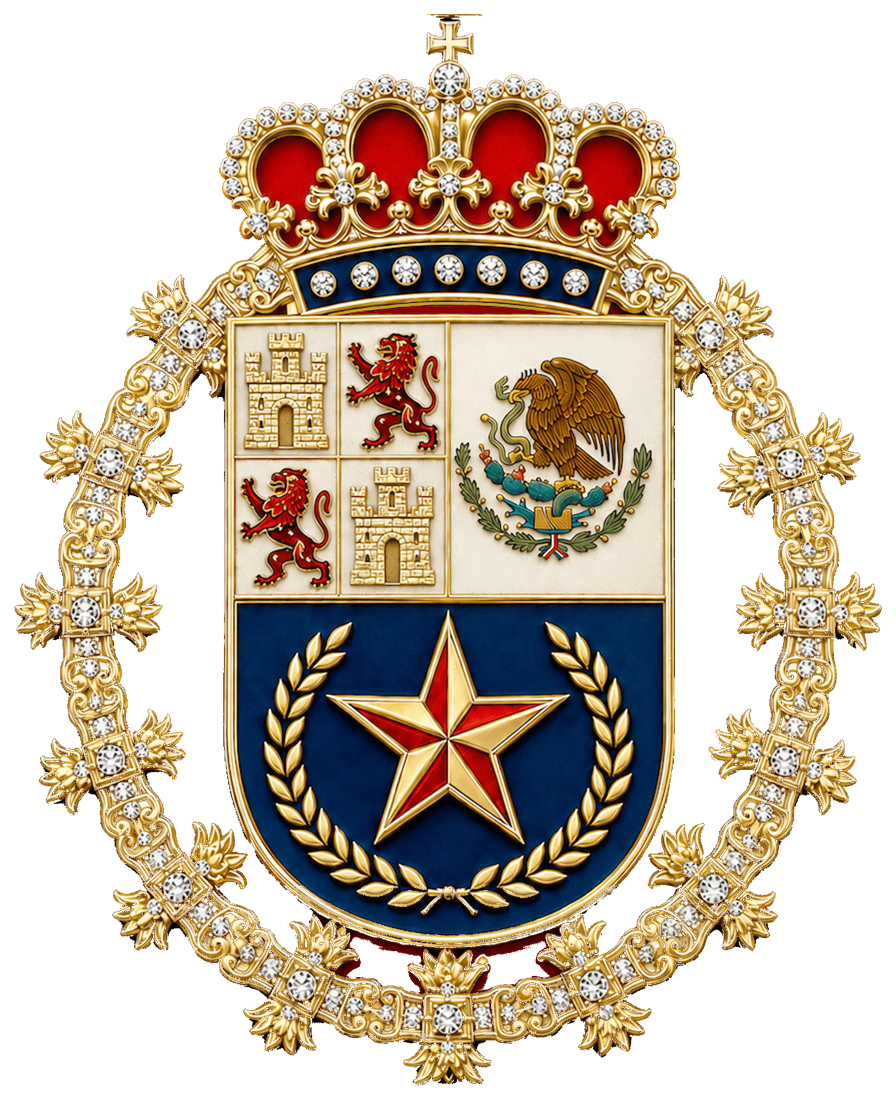
Blazon — Per fess: in chief per pale, dexter quarterly Castile and León, sinister Argent the Mexican national emblem proper; in base Azure, a mullet Or between two laurel branches Argent; the escutcheon encircled by a collar of interlaced links Or, in the manner of the collar of the Golden Fleece, and ensigned with the royal crown of Spain. (Blazon rendered descriptively from the Society's emblem; no official blazon is published.)
Motto — Our History, Our Roots, Our Family / Nuestra Historia, Nuestras Raíces, Nuestra Familia
The genealogical and historical society of Hispanic Bexar, founded by Gloria V. Cadena in 1983 and chartered as a non-profit in 1987; its journal has appeared since 1983, now as the annual Yearly Register of translated censuses, marriages, baptisms, burials and wills. Among its publications is the Founding Canary Island Family papers series, including The Travieso Family Papers (2008), for the seventh founding family — the Isleño founders entered with the Canary Islands Descendants Association above. The hands and roots that uphold the escutcheon in the full emblem are the Society's motto pictured: history held up by the families who descend from it. Recorded here for identification; this entry implies no affiliation with, and no endorsement by, the Society.
Jose Eligio Sanchez
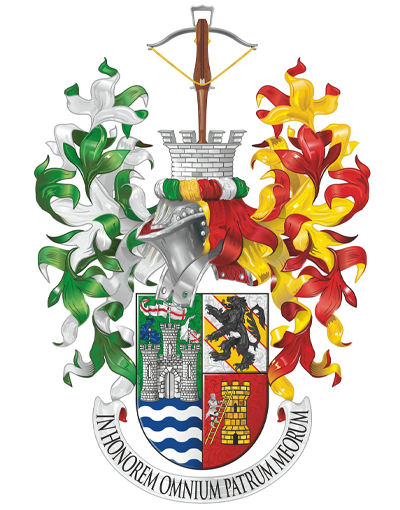
The armiger's arms in their full achievement, as displayed on his page of the register of the Society of American Armigers (depiction by Ljubodrag Grujic), shown here for identification.
Blazon — Per Pale to dexter Vert a castle triple towered Argent masoned Sable each Tower bearing a flagpole flying a pennant, the dexter Azure, the centre Argent a cross Gules and the sinister Argent a saltire Gules, on a Base wavy Azure three Barrulets wavy Argent; to sinister per fess in Chief Argent two Bends Or Fimbriated Gules overall a Lion ancient rampant Sable in Base Gules a Tower Or masoned Sable co-joint to dexter with a Scaling Ladder Or debruised by an Armored Knight Proper climbing up half way.
Crest — Issuant from a tower Argent masoned Sable a crossbow Proper.
Motto — In Honorem Omnium Patrum Meorum
A living armiger of Schertz, Texas — a retired major of the United States Air Force. He was born in Puerto Rico, in a military hospital near the castle of San Felipe del Morro at San Juan, which the triple-towered castle of the dexter half commemorates. His arms were certified by Don Vicente de Cadenas y Vicent, Cronista Rey de Armas, in Spain on 27 May 2004 (Protocol 6/2004), and are recorded in The Armorial Register (No. 0571, 2020), with the American College of Heraldry (No. 4209, 2020), and with the Society of American Armigers (No. AA0180, 2025). Schertz stands on the Bexar–Guadalupe line, and he is entered under this Roll's rule for the neighbouring counties (Guadalupe). Recorded here for identification; this entry implies no affiliation with, and no endorsement by, Mr. Sanchez.
Robert MᶜAtee
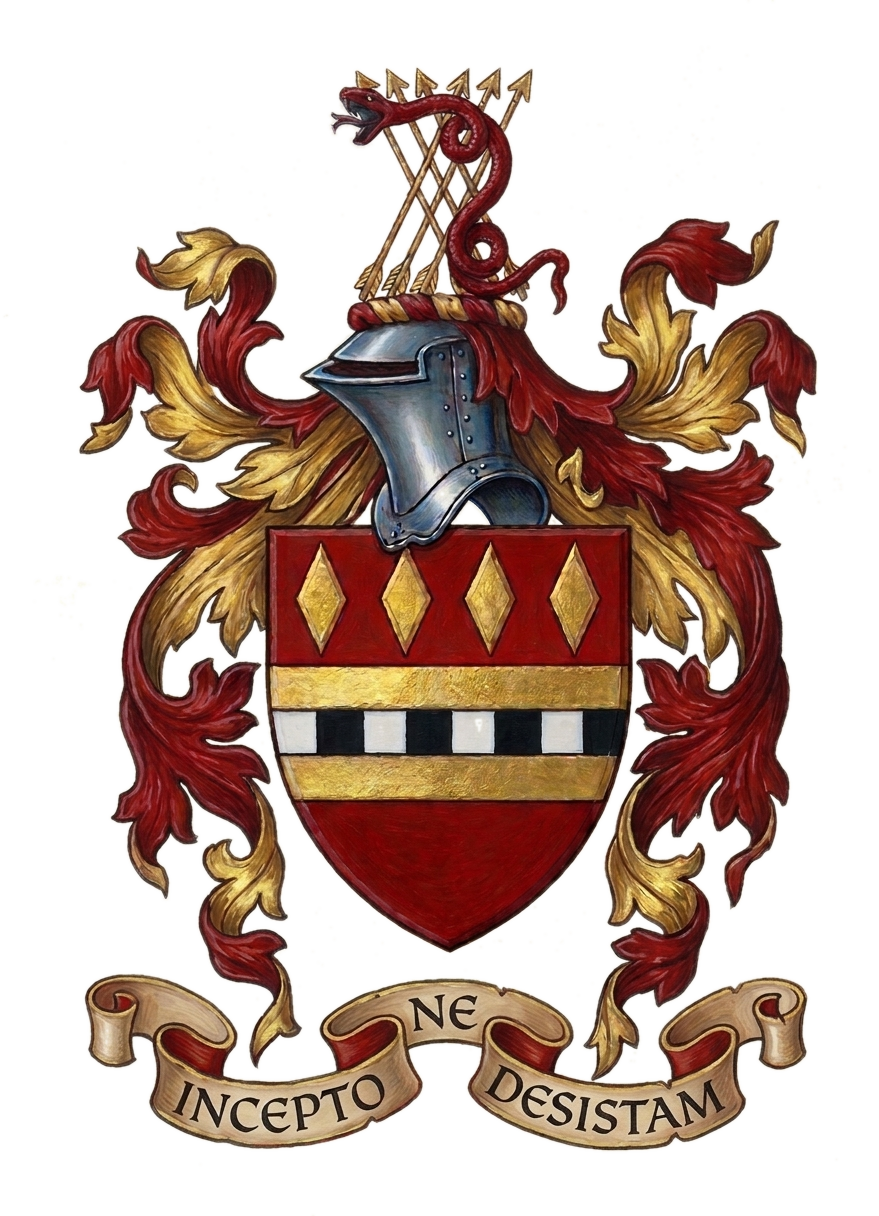
The armiger's own achievement, in the painted presentation rendering — the depiction the armiger himself chose for display. The vector master remains the rendering of record for the deed and the registries.
Blazon — Gules, on a fess Or a closet compony Argent and Sable, in chief four fusils in fess Or.
Crest — On a torse Or and Gules, six arrows, three in bend and three in bend sinister, points upwards, fretted Or, entwined by a serpent erect in pale wavy Gules.
Motto — Incepto Ne Desistam
The personal arms of the keeper of this Roll, assumed 7 August 2017 and borne by him and his lawful descendants. Entered here by the armiger himself.